Support our work
Be a disruptor! Your support helps us bring essential information to retailers, collegial organizations and consumers.


Over the last few years, the growth of the biotechnology industry has rapidly accelerated due in large part to an explosion in start-up companies and venture capital funding. Today, genetic engineering is no longer about a few agrochemical giants manipulating a handful of commodity crops. It’s also about engineering animals, gene-edited crops and novel ingredients brewed in vats in warehouses.
These new GMOs are largely unregulated and unlabeled, and they’re flying under the radar of the natural products industry. What’s more, many new GMOs are being marketed and sold to brands as “non-GMO.”
The Non-GMO Project is committed to keeping you informed so that you can operate with confidence in this new and quickly evolving landscape. Below, we offer resources to help you keep your goods non-GMO — so that you can deliver the natural products your consumers want.
If you’re a brand or a retailer, ask the right questions of your ingredient suppliers to ensure you’re sourcing non-GMO. What's the easiest way to avoid GMOs? Look for Non-GMO Project Verified products and ingredients!
Sometimes, these words describe techniques, processes and products of biotechnology. When sourcing, look for these descriptors; they may indicate the presence or use of new GMOs.
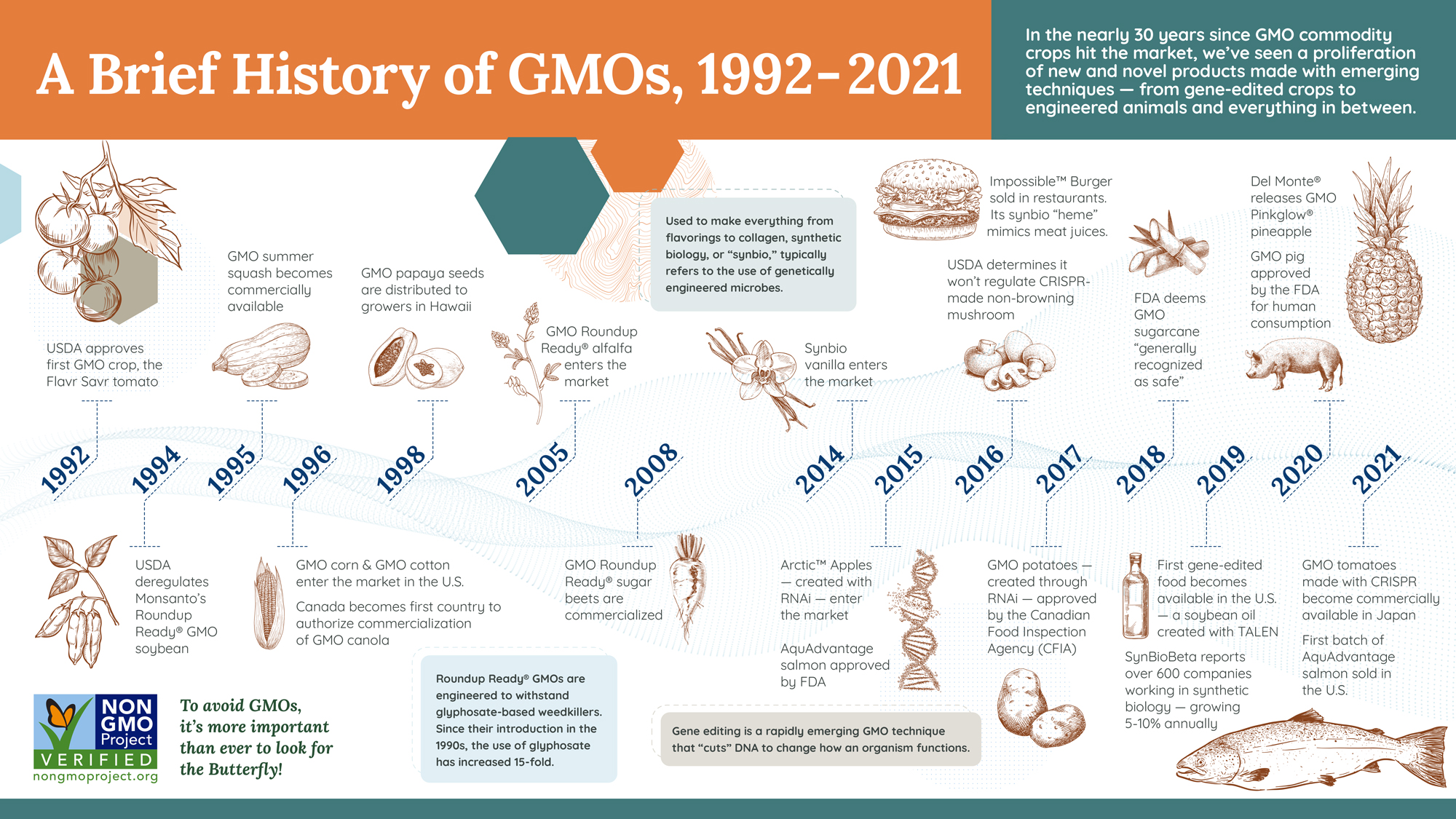
The GMOs in this timeline are the tip of the iceberg. Still, the downloadable infographic highlights how new GMO development is accelerating and broadening in applications and traits. Please share this resource with your customers and colleagues!
Watch our series on synthetic biology. Our seminars feature research, ideas, insights and opportunities related to new GMOs and their rapid rise into the supply chain. Join brands, retailers, distributors and industry thought leaders as we take a deep dive into the product categories impacted most by the entrance of new GMOs into our food system.
Be a disruptor! Your support helps us bring essential information to retailers, collegial organizations and consumers.

