
- Disease-carrying mosquitoes are the deadliest creature on Earth, and climate change and globalization are introducing them to new regions.
- Since 2019, over a billion “self-limiting” genetically modified mosquitoes have been released with limited independent data on the results.
- Another biotech solution, the gene drive, could permanently alter or eliminate wild mosquito populations — setting off ecosystem changes that can’t be undone.
- One GMO-derived ingredient, called NootkaShield, is starting to show up in insect repellents.
You’re drifting off to sleep on a glorious summer night when you hear it.
The noise is faint, but persistent: “Zzzzzzzzz… zzzzzzzzzzzzz…zzzz-zzzz.”
Immediately you are on high alert. You sit bolt upright, struggling to find the light, because now, before you sleep, you must hunt.
Our nervous system’s response to the buzz of a mosquito might seem like an overreaction — it is, after all, a tiny thing — but there’s wisdom in it. While a mosquito bite can be an annoyance that passes in a few days, it can also transmit diseases that disable, or even kill.
Effective strategies to reduce mosquito-borne disease transmission aren’t just big business. They could save hundreds of thousands of human lives each year. Following some of the recent advances in gene editing, the biotech industry is entering the chat in a big way.
To better understand just what’s at stake, let’s start with some surprising, sobering and seemingly contradictory facts about mosquitoes:
- Fact #1 — The overwhelming majority of mosquito species don’t bite, and the few species that do generally prefer non-human prey. Maybe we’re too slappy?
- Fact #2 — The biters — made up of females from only 6% of all mosquito species — take their vocation very seriously. Anyone who has gone camping or hiking, or tried to enjoy a cookout can confirm this.
- Fact #3 — Some biting mosquitoes carry blood-borne illnesses that infect millions of people each year, including diseases such as malaria, dengue, Zika, chikungunya and West Nile.
For their role as a disease vector, the minority of mosquitoes have earned the dubious distinction of “world’s deadliest animal.” And they’re on the move.
Migrating mosquitoes
In our chaotic and warming world, things simply don’t stay put. People and goods are shipped all around the world. Technology developed for one purpose finds applicability in another. Insects travel, too, finding homes and hosts where they are least expected.
“Twenty years ago, if you said we were going to have chikungunya and dengue in Europe, everybody would have said you were mad,” theoretical ecologist Dr Steven White told The Guardian. “These are tropical diseases. Now everything’s changed. This is down to this invasive mosquito and climate change – it really is as simple as that.”
In 2025, France and Italy saw alarming outbreaks of chikungunya consisting of locally-acquired cases. “Locally acquired” is an important differentiator, meaning the disease was not contracted abroad by travellers and brought back to the EU, it is being transmitted by invasive Asian tiger mosquitoes (Aedes albopictus) which are now established across southern Europe. The whole transmission cycle is occurring in countries that had no history of this disease a generation ago.
As mosquito-borne diseases gain a foothold in regions with no historical exposure and little immunity, the pressure to find new solutions is intensifying. These newly affected communities in the Global North — which are also where research is funded, policy is set, and decisions about novel technologies are made — now have a personal stake in the outcome.
Genetically modified mosquitoes
Self-limiting and “Friendly”
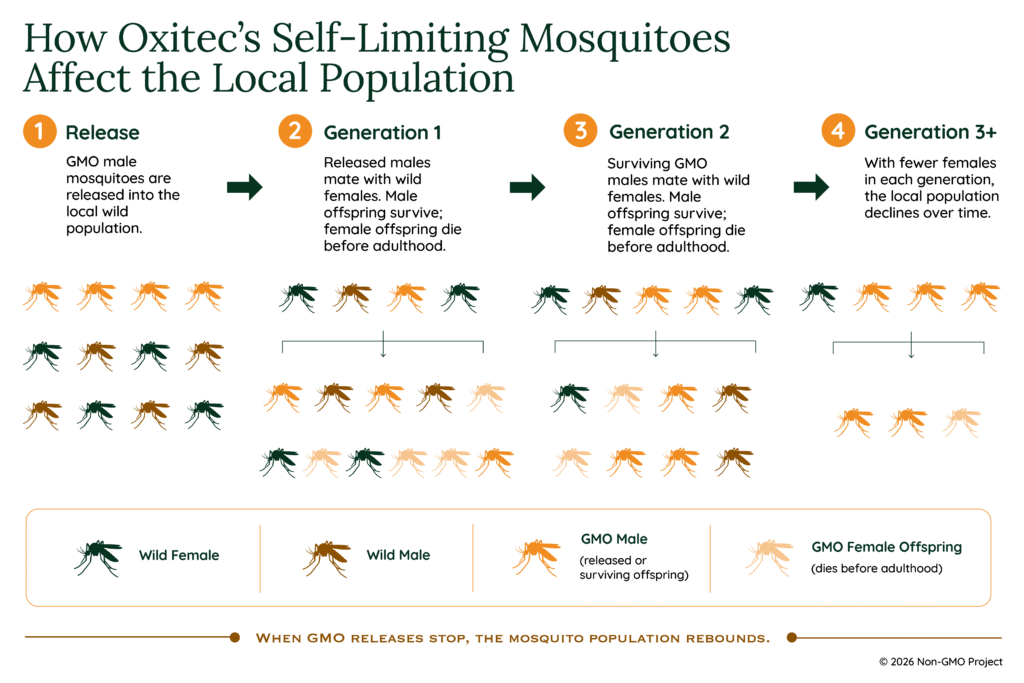
Since 2019, British biotech company Oxitec has released more than a billion genetically modified Aedes aegypti mosquitoes in Brazil, the Cayman Islands, Malaysia, Panama and the US. The released insects are self-limiting, non-biting male mosquitoes that introduce a gene into wild populations that is lethal to female offspring. Here’s how it works: Released male GMOs mate with wild females, passing along the genetically engineered gene that kills off female offspring before they reach maturity. With a steadily diminishing female population, each subsequent generation produces fewer mosquitoes. The released GMOs have been trademarked as “Friendly” mosquitoes, because males do not bite. They also carry a fluorescent marker gene so researchers can identify them in the field.
Analyzing the impact of Oxitec’s releases is complicated by the fact that different stakeholders seem to be measuring different things. To date, there is little publicly available information or independent peer review. Here’s what some of the loudest voices have to say:
- Oxitec claims that the Brazil and the Cayman Islands trials led to reductions between 80-95% in the local Aedes aegypti population.
- A 2019 analysis from Yale University found evidence that genes from the modified males had persisted in the wild population after one trial in Brazil, raising questions about the efficacy of the self-limiting mechanism. Oxitec disputed the findings. The analysis was neither cleanly vindicated nor fully retracted.
- Friendly mosquitoes’ impact on disease transmission has not been analyzed, and data from the Florida Keys trials is still awaiting EPA review.
The US launch of Oxitec’s Friendly mosquitoes has been contentious: Florida-based tests between 2021-2024 evoked strong opposition from local environmentalists. Similar plans in California were canceled in 2023 following pushback. And while opposition to GMOs often includes environmental concerns or a lack of meaningful public engagement — both of which apply here — the Friendly mosquito also carries a safety concern that is unique to this particular GMO.
Critics argue that some females are slipping through the self-limiting net and surviving to adulthood. The culprit could be accidental exposure to tetracycline.
Oxitec genetically engineers their mosquitoes so that female offspring die unless they receive regular doses of tetracycline, a common antibiotic. In the lab, Oxitec supplies the antibiotic to keep females alive for breeding, releasing males into the wild. Those males breed with wild females, passing along the tetracycline-dependent trait. The daughters of that pairing inherit the lethality gene and, without tetracycline, die before reaching maturity.
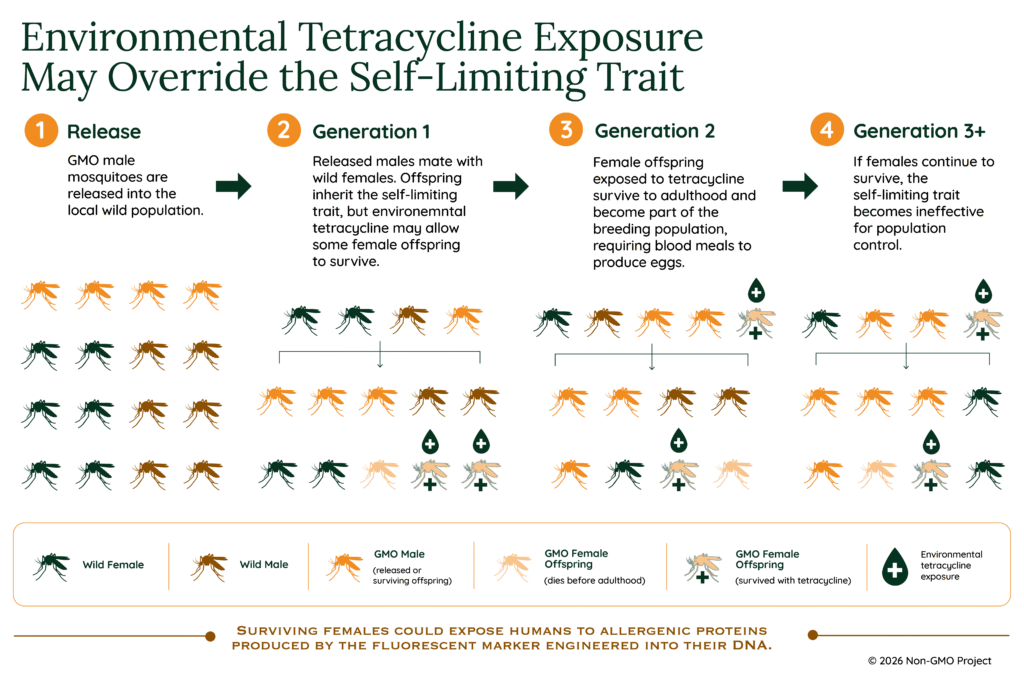
However, tetracycline is an incredibly common medication. It shows up in wastewater, excreted from human and animal patients being treated with it, and it’s used in agriculture to combat citrus greening disease — a scourge in citrus-heavy Florida. If the Friendly mosquitoes’ daughters encounter enough waste tetracycline in the environment, they will live, bite and have little larvae of their own. Their bites could expose humans to an allergenic protein from the fluorescent marker that helps identify them to researchers.
In a welcome, if tardy, turn of events, the EPA convened a panel in 2025 — several years after the Florida releases — to assess the risk posed to humans. That means that regulators are currently building a test for a risk they said was negligible at the time of exposure.
Meanwhile, the company behind the Friendly mosquito is not resting on its laurels. Oxitec Australia is developing additional self-limiting insects, including Aedes albopictus mosquitoes (the same variety behind the EU’s chikungunya outbreaks) and a fall armyworm intended to curb an invasive agricultural pest threatening food crops; these GMOs have not yet been released.
Driven to extinction
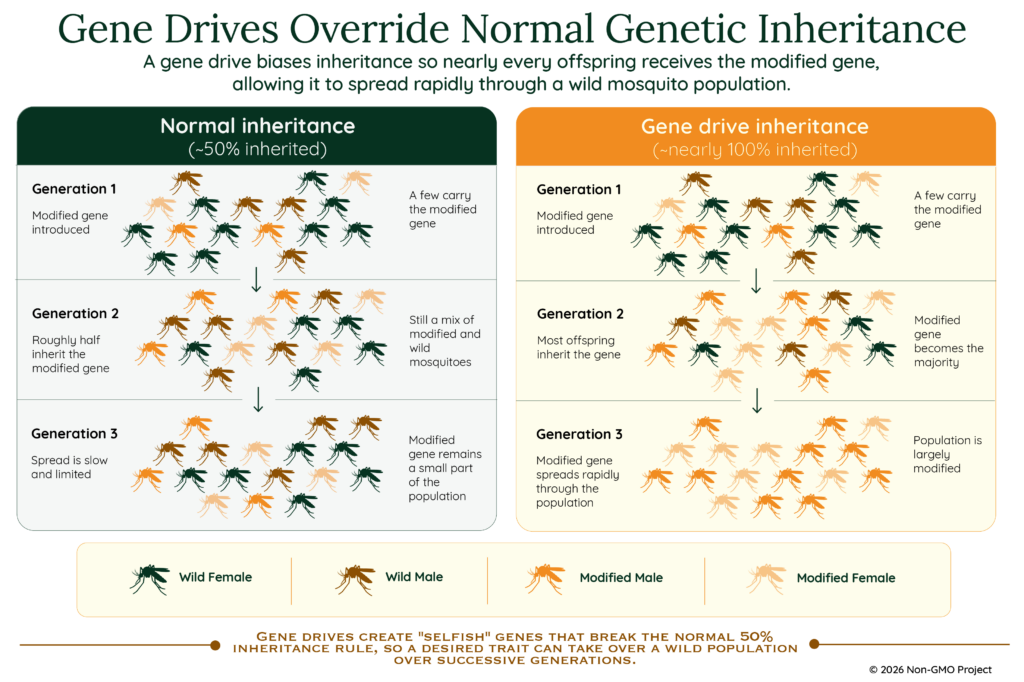
Gene drives are a controversial tool in the biotech toolkit because of their potential to transform ecosystems. They work by overriding the normal rules of genetic inheritance, so a desired trait (in this case, something that reduces mosquitoes’ capacity to transmit disease) spreads through an entire wild population over successive generations. Normally, a given gene has a 50% chance of being passed on to offspring; a gene drive establishes a “selfish” gene which spreads rapidly through the population.
Most of the advanced research around gene drives in mosquitoes relates to malaria prevention. Some researchers are exploring gene drives that could make the mosquitoes less hospitable to the parasites that cause malaria. Others seek to suppress the number of mosquitoes by interfering with their reproduction — or, eliminating them entirely.
Both of these paths could have far-reaching impacts that are difficult, if not impossible, to prepare for. Suppressing a population (i.e., reducing their number or eliminating them entirely) removes the vector for disease, but could create problems in a complex ecosystem, where the effects of a deliberately engineered absence are impossible to predict. On the other hand, replacing a population with genetically modified versions that resist a pathogen may sound less dramatic, but it places evolutionary pressure on the pathogen to adapt around the resistance, which could lead to the evolution of a more dangerous pathogen.
Early research has also begun into gene drives to limit the transmission of West Nile by Culex quinquefasciatus mosquitoes.
Gene drives aren’t unique to mosquitoes — they could be developed for use in any number of organisms. So far, they have been engineered into fruit flies and lab mice and scientists see potential for agriculture and conservation efforts.
Not-so-natural nootkatone
When GMOs aren’t being deployed to reshape or wipe out entire species, they are still showing up as ingredients in personal care products, including insect repellents (for more on GMO ingredients in skin care, cosmetics and fragrances, check out our pocket guide). So-called “new GMOs” — a class of biotech tools that go beyond the traditional commodity crops engineered to withstand weedkiller applications — are overrepresented in personal care products. New GMOs include synthetic biology (or synbio) techniques, in which a genetically modified microbe is engineered to produce a compound that’s useful in manufacturing. Synbio nootkatone is one such compound.
Nootkatone is found naturally in small amounts in grapefruit skin and Alaska yellow cedar trees. It is already used extensively as both a scent and flavor in the fragrances and food. But, it has another potential function: the compound activates octopamine receptors in mosquitoes and some other biting insects, causing them to “vibrate themselves to death.” Humans, who don’t have octopamine receptors, are unaffected by it. In light of this new application, manufacturers are turning to genetic engineering to increase production.
In 2020, the EPA announced its approval of a genetically engineered nootkatone developed by the biotech company Evolva. It’s interesting that the company’s webpage for this product is titled “Natural Nootkatone.” Text on this page referencing precision fermentation appears over images of citrus groves and sliced grapefruits — not fermentation tanks, laboratories or technicians developing genetically engineered nootkatone. The juxtaposition seems genuinely confusing to site visitors.
Genetically engineered nootkatone is available to other product formulators under the brand name NootkaShield, and is appearing in insect control products in Asia, such as EXOUT Insect Repellant and Familoves.
Beyond the data
Underlying the convoluted details of using GMOs for insect control is something simpler, foundational and uniquely human: Consent.
Trust depends on transparency. That principle is equally true whether the work at hand is the release of a novel organism, or the labeling of a GMO ingredient in insect repellent or a new bioengineered food. Currently, public trust is at a low ebb. According to the Kaiser Family Foundation, it cratered during the pandemic and has not recovered since. And if you are tempted to reject this finding because, hey, why trust a massive institution that doesn’t know you at all but is telling you how you feel — we see you. We sympathize. But that train of thought proves the point.
When institutions launch initiatives that are communicated poorly — or not at all — they are training the public to practice suspicion. And, as with anything we practice, we get very good at it. We’ve seen this in Brazil, where communities felt they were denied meaningful input into Oxitec’s Friendly mosquito trial, and in Florida, where in 2021, residents had a few days’ notice of the mosquito release, with no public comment or informed consent beforehand. We’ve also seen it in the grocery store, where GMO food labeling didn’t happen until 20 years after GMOs were introduced into the food supply — that’s why the Non-GMO Project exists.
Public engagement is not peripheral to scientific advancement, it is key to progress and success. People expect to have a say in decisions that affect their lives and livelihoods. When that expectation is violated, it doesn’t just damage trust in a single product or company. It damages trust in the institutions that should be working in the public interest.
This isn’t a story about public resistance to new technology. A 2026 study from Mali — which has one of the highest malaria burdens — found that 77% of respondents would accept genetically modified mosquitoes if they were proven safe and tested in controlled conditions first.
Picture this whole issue as a seesaw. On one end is the suffering caused by mosquito-borne diseases, which infect hundreds of millions of people each year. On the other end are the unknowns of a novel technology deployed in a complex and interconnected ecosystem. In the middle, at the fulcrum, are the people whose lives are shaped by both.
You’d ask questions, too.
FAQ
Are mosquito-borne diseases a risk in the US, Canada and Mexico?
While some mosquito-borne diseases are present in the US and Canada, assessing your personal risk depends on lifestyle factors such as where you live and travel, time spent outdoors, whether you are in a vulnerable group.
- West Nile virus, transmitted by Culex mosquitoes, is the most common mosquito-borne disease in North America. Most infections cause no symptoms, but a small percentage result in serious neurological complications.
- Dengue, Zika, and chikungunya are spread by the Aedes aegypti mosquito, which is currently established across Mexico and the southern US, and expanding northward as temperatures rise. Locally acquired cases are emerging in southern states, and Zika is of particular concern for pregnant people, as infection can cause serious birth defects.
- Malaria is not endemic in North America, and most cases are associated with travel to malaria-prone regions. However, in 2023, the US recorded its first locally acquired malaria cases in two decades.
What are my options for a natural or non-GMO insect repellent?
There are several effective options that don’t involve GMO-derived ingredients — search the EPA database for products with citronella oil or oil of lemon eucalyptus as the active ingredient. Catnip oil is also a promising compound. A 2026 study found that a lotion containing 6% catnip oil was as effective as DEET at repelling mosquitoes. It is also inexpensive, plant-based, and can be grown in a wide range of climates and locales.
One note for Non-GMO Project shoppers: nootkatone, an insect-killing compound found naturally in grapefruit and Alaska yellow cedar, is increasingly produced via precision fermentation using genetically engineered yeast. Genetically engineered nootkatone is available to manufacturers under the product name “NootkaShield.” Check ingredients lists carefully if avoiding GMOs is a priority.
What non-GMO options exist to reduce mosquito populations and/or disease transmission?
There are a range of non-GMO approaches that target mosquito populations or disease outcomes directly.
- Physical interventions — Include reducing the insect’s access to people, such as through bed netting or protective clothing, or reducing the standing water needed for breeding.
- Chemical interventions — Non-GMO insecticides and larvicides, though overuse can drive resistance in mosquito populations.
- Bacterial interventions — The Wolbachia method introduces a naturally occurring bacterium into Aedes aegypti populations that reduces their ability to transmit dengue, Zika, and chikungunya. Unlike GMO approaches, Wolbachia establishes itself permanently in wild populations without ongoing releases.
- Sterilization — The release of male mosquitoes that have been sterilized by radiation — this is a precursor to Oxitec’s approach to self-limiting GMOs.
- Medical treatment — Vaccines are available for yellow fever, dengue and malaria (though with limitations). Advances in medical treatment continue to reduce the severity of disease even when transmission occurs.
However, no single intervention works against all mosquitoes in all contexts. Effectiveness depends on the species, its behavior and the disease in question. For example, bed netting can be effective against malaria transmission because malaria is spread by Anopheles mosquitoes that only bite at night; the same tool would be ineffective against Aedes mosquitoes, which carry dengue and Zika, because they are active during the day.
What’s the difference between self-limiting GMO mosquitoes and gene drives?
Self-limiting mosquitoes, such as Oxitec’s Friendly mosquitoes, are genetically engineered to produce offspring that die before reaching maturity to reduce the mosquito population. Researchers insert a gene which codes for a protein which becomes toxic to the mosquito. The reduced numbers of mosquitoes should, in theory, reduce disease transmission.
A gene drive works by overriding the normal rules of inheritance through genetics, causing a desired trait designed by researchers to spread through and persist in the wild population.
Do GMO mosquitoes reduce disease transmission?
We don’t yet know.
Oxitec’s Friendly mosquitoes are the only genetically modified mosquitoes released to date. The company reports population reductions of 80-95% at trial sites, but population suppression and disease transmission are different metrics — the latter has not been independently measured, the former has not been independently verified. Gene drives in mosquitoes have not yet been released into the wild.
