
- Biotechnology companies are developing food colorants derived from GMOs — and marketing them as non-GMO and natural.
- The shift is driven by US government agencies encouraging brands to move away from synthetic, petroleum-based colors that may pose health risks, particularly to children.
- Non-GMO alternatives from natural plant and animal sources exist, but pose real challenges for brands around consistency, stability and cost.
All eyes on food dyes
In the past several years, a wave of state and federal actions aimed at removing petroleum-based dyes from the food supply has created a major inflection point in the industry — and a potential market opening for biotechnology companies.
As advocacy for a more natural food supply grows, regulators are taking aim at synthetic, petroleum-based color additives commonly used in food, cosmetics and medicine. Petroleum-based colors — which include Red 40, Yellow 5, Yellow 6 and more — have been scrutinized for links to health issues, including behavioral changes in children.
While federal agencies approve non-petroleum alternatives and update labeling guidelines to encourage industry adoption, several states have placed restrictions or outright bans on some synthetic color additives.
Now, food manufacturers are faced with figuring out what to use instead. Enter the GMO. Biotechnology companies are developing a new category of color additive, produced through genetic engineering and marketed to manufacturers as consistent, natural — and non-GMO. However, these marketing claims paint an incomplete picture, and make it nearly impossible to distinguish between color additives from natural sources and those made through genetic engineering.
Precision fermentation: Going "natural" with GMOs
We've covered precision fermentation previously in the context of animal-free dairy proteins, beer ingredients and GMOs in chocolate. It's a synthetic biology, or "synbio," technique in which genetically engineered microorganisms, such as yeast, algae or bacteria, are programmed to produce a specific compound through fermentation. The compound could be nearly anything, including a scent, flavor or protein. In the products we're looking at here, they're color additives that can be used in food.
Synbio food dyes made through precision fermentation aren't a "someday, down the road" concern. Several biotech companies are already producing color additives this way:
- Danish company Chromologics uses precision fermentation to produce Natu.Red, a red food coloring with suggested utility in protein alternatives, processed meat, baked goods, yogurt and ice cream.
- US-Argentinian startup Michroma develops "clean-label ingredients" from genetically engineered mold, including Red+, a synbio colorant described on their website as natural and non-GMO.
- Israeli biotech company Phytolon produces color additives on the yellow-to-purple spectrum, including "beetroot red," which is made from genetically engineered baker's yeast rather than beets. The FDA recently announced its approval of beetroot red, and review of an additional product, prickly pear yellow, is currently on hold.
A GMO by any other name
Current labeling rules don't just fail to identify GMO-derived color additives — in some cases, they actively mislead shoppers.
"No artificial colors" on products made with GMO dyes
Until recently, "no artificial colors" signaled the absence of color additives, regardless of their source.
However, FDA guidance intended to incentivize manufacturers to abandon petroleum-based dyes has shifted that definition: "artificial" now means petroleum-based, and only petroleum-based. Color additives derived from GMOs are not distinguished from those derived from plants, animals, or minerals, and products containing dyes from either of these sources can now carry a "no artificial colors" claim.
Natural and non-GMO claims
Compounds produced through precision fermentation are extracted from the genetically modified microbial broth that produced them, then purified before being used as food ingredients.
By the time synbio food dyes reach a finished product, they may contain no detectable modified DNA — allowing them to bypass the USDA's mandatory bioengineered (BE) food disclosure and, in some cases, opening the door to "non-GMO" marketing claims.
This logic isn't new. Earlier waves of synbio ingredients have consistently downplayed the role of genetic engineering in their production — a process that critics describe as "extreme genetic engineering."
- EuropaBio markets their synthetic vanillin as "natural"
- Fooditive describes their animal-free casein as "dairy identical"
- Conagen announced a food preservative produced through precision fermentation as "natural, non-GMO"
The pattern is consistent: engineer a microbe to produce a compound, extract and purify the compound, then position the result to meet consumer demand for "natural" ingredients.
Synbio food dyes are the latest ingredient to follow this playbook. As the Center for Food Safety, a nonprofit that advocates for stricter food safety regulations, has pointed out: "If their [synthetic biology] products were really 'natural,' they would not be applying for patents on their new inventions."
"Beetroot" without beets
Some biotech companies are seeking government approval for dyes whose product names closely mirror those of their natural, plant-derived counterparts.
The recently approved, GMO-derived "beetroot red" is a perfect example. The name sounds like an ingredient made from beets — and a shopper who reads labels carefully, who actively tries to avoid GMOs and petroleum-based dyes, would reasonably conclude that a product listing "beetroot red" was colored with something derived from beets.
That conclusion would be wrong.
Beetroot red is produced by genetically engineered baker's yeast.
Calling a GMO-derived ingredient by the name of its natural counterpart exploits the trust of even the most highly engaged shoppers, undermining their ability to make an informed choice about the foods they buy.
Our position
The Non-GMO Project's position is straightforward:
Consumers have a right to know how their food is made, not just what's chemically detectable in the final product.
Genetic engineering is a significant intervention in the food supply. Whether or not engineered DNA survives into the finished ingredient, shoppers should be able to choose products that align with their needs.
Current labeling rules do not give them the information they need to do that.
What are the truly non-GMO options?
Color additives are very common in the US food supply — a 2025 study found that 19% of products from major manufacturers were made with synthetic food dyes.
Before the recent development of synbio options, color additives fell into two broad categories: the synthetic, petroleum-based dyes that regulators want to see phased out, and naturally-sourced dyes derived from plants, animals and minerals.
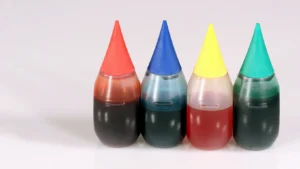
Petroleum-based colors
Petroleum-based dyes became popular because their vibrancy, consistency and color-fastness made them well-suited to the rigors of industrial manufacturing. Over time, our exposure to them has grown dramatically — in the 21st century, Americans consume five times more petroleum-derived food coloring than their grandparents did.
Natural colors
Many natural color additives sourced from plants, animals and minerals have been used since ancient times. However, there are practical limitations to natural colors, which include compounds like beet juice, turmeric or spirulina.
The color quality of naturally-sourced dyes may be inconsistent, the tinting strength weak. In practice, a brand reformulating with beet juice instead of Red 40 may need substantially more of it to achieve the same color, enough to alter the product's flavor, texture or consistency.
Natural colors fade more quickly. Color-fastness, a core selling point of synthetic dyes, is not something the natural world prioritizes.
A question of safety
The push to remove petroleum-based dyes from the food supply was driven by one thing above all else: concern about what those dyes might be doing to our health, particularly children's health. A growing body of research has uncovered possible links between petroleum-based food dyes and behavioral issues in children.
Natural options, even those sourced from non-GMO plants and animals, may pose risks of their own. They aren't subject to the kind of batch-by-batch oversight that has applied to synthetic, petroleum-based dyes. Additionally, naturally-sourced dyes may contain allergens, pesticide residues, or other contaminants, and the solvents used to purify them pose their own health risks.
From a safety standpoint, are the novel compounds made through genetic engineering techniques any better? Consider how companies making synbio ingredients have already navigated safety rules.
Synbio compounds have entered the food supply as "GRAS" — Generally Recognized as Safe — a designation originally created for ingredients with a long history of human consumption, like vegetable oil or vinegar.
The pathway rests on a concept called "substantial equivalence": if a compound is claimed to be similar enough to something with a known safety history, it can inherit that safety status.
Crucially, there is no FDA oversight of this determination — companies self-certify.
There is already controversy over this process, such as when independent testing of Perfect Day "milk-identical" animal-free dairy protein allegedly found that the product was actually quite different — composed largely of fungal proteins rather than whey, and containing 93 compounds not present in cow's milk, most of which couldn't be identified. (Perfect Day disputes the allegations and the case is ongoing.)
The flaws in this logic become even more apparent when it is applied to synbio dyes. These compounds are different from their natural counterparts — that's the point. The natural versions didn't meet manufacturers' needs, so synbio versions were engineered.
Food dyes produced through synthetic biology are too new to have accumulated much in the way of rigorous, independent research. That's not an accusation — it's simply the nature of novel ingredients and, well, time. But it does mean that consumers being asked to accept these ingredients as safe, clean alternatives are being asked to take that on faith.
The bigger question nobody's asking
Amid all of this, it's worth stepping back and asking a question that rarely comes up: why does "real food" need to be dyed at all?
The federal push to reshape the food supply has been framed in part around a return to real, whole, less-processed food — a worthwhile goal.
But color additives don't make food healthier, safer or more nutritious.
They exist to make food more visually appealing, or to signal qualities that may not actually be present (think: cherry flavored products that are bright red but contain no actual fruit, or imitation crab meat dyed orange to mimic the appearance of real crab). Even a natural dye extracted from a radish or beet doesn't impart the nutritional benefit of the vegetable it came from.
Many of the products most likely to contain added colors are also ultraprocessed, nutrient-poor, and high in sugar, fat, and salt, such as candy, soda, snack foods and breakfast cereals — notably, products that are aggressively marketed to children. Petroleum-based color is rarely the only problem with ultraprocessed foods, but it is a reliable signal of what else you're getting.
If the main driver of poor health outcomes in the US is the dominance of ultraprocessed food — which the research increasingly supports — then the debate over what those products are dyed with may be a distraction from the more important question of why we keep making them. It's a system that benefits an industry whose brands depend on consistent, vibrant shelf-stable color, while the people eating those products — disproportionately children the products are designed to attract — absorb the risks.
Beyond the label
The labeling landscape, particularly around food dyes, is genuinely confusing. Definitions that meant one thing a few years ago mean something different today, and some claims may be technically accurate but functionally misleading.
However, an imperfect system makes a strong argument for reading labels more critically, not for giving up on them entirely.
Understanding what's on a label (and what's missing) is one of the most direct ways to advocate for the kind of food supply you want to see.
So yes, keep reading labels.
Some information is better than none, and over time you'll develop a sense of which claims matter most to you and which products you can trust.
For more specific goals, here's where to focus:
- To avoid petroleum-based color additives familiarize yourself with the names in the list below. They may appear in full ("FD&C Red No. 40") as abbreviations ("Red 40") or as generic alternatives ("Allura Red AC") on ingredient panels.
- To avoid synbio-derived color additives look for the Non-GMO Project Butterfly on food and personal care products. Be aware that some synbio dyes are being approved under names that sound natural — it's too soon to know how "beetroot red," for example, will be listed on food products, but we'll keep you posted.
- For the most comprehensive protection look for products that are both Non-GMO Project Verified and USDA certified organic. Organic certification restricts synthetic color additives and products of genetic engineering; Non-GMO Project verification adds an additional layer of scrutiny with specific attention to products of synthetic biology. Together, we consider them the gold standard.
- To reduce your exposure to color additives altogether consider shifting away from ultraprocessed foods. UPFs are the category in which food dyes are most heavily concentrated and the potential benefits of reducing ultraprocessed food intake go well beyond dyes. Learn more about UPFs here.
The reddest flags
Petroleum-based color additives can appear on ingredient panels under several different names. Here's what to look for:
- Red 3 — also listed as FD&C Red No. 3 or erythrosine
- Red 40 — also listed as FD&C Red No. 40 or Allura Red
- Blue 1 — also listed as FD&C Blue No. 1 or Brilliant Blue
- Blue 2 — also listed as FD&C Blue No. 2 or indigotine
- Yellow 5 — also listed as FD&C Yellow No. 5 or tartrazine
- Yellow 6 — also listed as FD&C Yellow No. 6 or Sunset Yellow
As for synbio dyes: because they may be listed under names that mirror their natural counterparts, they are significantly harder to identify on a label. These dyes may not be widely used in the food supply yet, but the groundwork is being laid. When they do arrive, a 'beetroot red' listing will not tell you whether the ingredient came from beets or from a genetically engineered microbe. This is precisely why third-party verification matters — and why the Non-GMO Project exists.
FAQ
Which food dyes are being phased out?
Synthetic, petroleum-based color additives are being phased out. Several states have passed restrictions on the use of these dyes in food sold or served in schools, and the federal government is working with food manufacturers to replace them.
Do synthetic food dyes affect children's behavior?
Research suggests they might, particularly in children who already show signs of attention or behavioral issues. Multiple studies have found links between synthetic dye consumption and adverse behavioral outcomes in children, prompting California's environmental health agency to conclude that the association is worth acting on.
The science isn't settled — no study has proven that petroleum-based dyes directly cause behavioral problems in every child, or even most children. But the pattern of evidence is sufficient that regulators have taken notice. It's worth noting that children are particularly vulnerable due to their developmental stage and the large volume of products containing dyes which they are exposed to.
Are there other health concerns beyond children's behavior?
Most of the research on synthetic dyes has focused on children. However, there is some data on other population groups that might influence your decisions:
In 2025, the FDA revoked Red No. 3 after decades of evidence linking it to cancer in laboratory animals, though it's unclear if humans face the same risk. Allergic responses to petroleum-based food dyes are also a possibility, but there is not enough evidence to show widespread risk or serious reactions.
The bottom line is: the research is incomplete, the regulatory response has been slow and the people with the least power to opt out — children, whose diets are largely decided for them — are the most exposed. That's the context worth keeping in mind when weighing how much any of this should matter to you personally.
Are food dyes made with synthetic biology considered GMOs?
Yes, all products of synthetic biology are considered GMOs under the Non-GMO Project Standard.
What does "natural food coloring" actually mean?
The term is less certain than you might think. While the FDA does not formally define "natural," in practice, "natural food coloring" has come to mean any color additive that isn't derived from petroleum. However, this leaves a significant gap.
That gap is where synbio food colorings fit in. Color additives produced through genetic engineering are not petroleum-based and therefore may be accompanied by "natural" claims and "no artificial colors" labeling under current rules.
The Non-GMO Project considers this characterization misleading. A product of genetic engineering is not a natural product.
What is precision fermentation?
Precision fermentation is a synthetic biology technique in which genetically engineered microorganisms — GMOs such as yeast, algae or bacteria — are programmed to produce a specific compound. The technology has existed for decades but has only recently gained steam in the food supply.
The engineered microorganisms are cultivated in industrial fermentation tanks and fed simple sugars to fuel the fermentation process. Once the target compound is produced, it's extracted and purified, which typically removes most or all of the modified genetic material from the final ingredient — the absence of genetically modified DNA in the final product is the basis for "non-GMO" marketing claims. Additionally, because color additives made through precision fermentation aren't derived from petroleum, they qualify as "natural" under current labeling guidelines. However, both claims paint an incomplete picture of the product.
The Non-GMO Project’s Standard defines all crops and products developed using biotechnology, including new gene-editing techniques, as GMOs. We share this information to further one of the Project’s primary goals of creating greater transparency in the supply chain, ensuring you have the information you need to make the best choices for you, your brand, and your family.
Please note that the information herein is for general informational purposes only and is based on the linked sources above.
The Non-GMO Project is a 510c3 nonprofit dedicated to protecting and promoting non-GMO alternatives. New GMO Alerts is supported by funding from readers like you. Donate today.