

EVYLO in a nutshell
EVYLO started with a personal goal.
When I entered my 40s, I began thinking more seriously about longevity and the foundations of long-term health — especially heart and metabolic wellness.
Along the way, I looked into many dietary supplements. I found a crowded market with many options — maybe too many. Yet, I struggled to find supplements that met my standards for scientific support, quality and transparency.
One issue especially stood out: whether there is strong evidence behind many supplement ingredients.
Despite bold marketing claims, the scientific support for these ingredients can vary widely. That’s why it’s important to look closely at the evidence behind a product.
Some ingredients are supported by strong clinical research with human subjects. Others rely on limited or inconsistent evidence. Some studies show mixed results, or the research derived mainly from early lab or animal studies.
Without well-designed human studies, it is often difficult to know what benefits an ingredient may actually provide, or how well it has been studied for safety.
A supplement ingredient is not considered safe simply because it is natural. For example, many mushrooms that grow in the wild are toxic. An ingredient’s safety depends on the evidence supporting it.
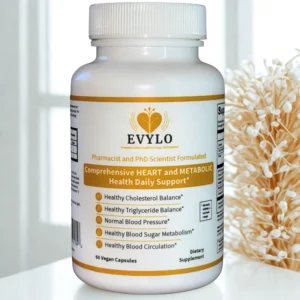
Instead of settling for something that felt like a compromise, I decided to create the kind of supplement I wished already existed. That effort eventually became EVYLO.
Our approach to developing EVYLO
For EVYLO, we focused on what truly matters for supporting normal heart and metabolic wellness. We began with a clear goal: to develop a supplement using ingredients and daily amounts informed by high-quality, human clinical research.
We then reviewed more than 400 potential ingredients and dietary approaches, focusing on appropriate daily amounts, relevant health markers, and both positive and negative scientific findings. We placed particular emphasis on well-designed human clinical studies. We also considered potential interactions with food, medications and other supplements.
This balanced and evidence-guided approach allows us to take EVYLO ourselves with confidence, and to focus on what may truly help healthy consumers support their heart and metabolic health goals.
Quality, testing and certification
Besides the science, we closely monitored the entire development process. This includes ingredient sourcing, supplier qualification, manufacturing, and finished product testing and certification.
Every detail matters, because we are talking about consumer health.
Our pursuit of quality and transparency earned EVYLO dual NSF Contents Certified and BSCG Certified Drug Free status.
EVYLO is also the first NSF Contents Certified dietary supplement featuring berberine and bergamot in a comprehensive formulation.
These certifications show that EVYLO meets strict NSF standards, including:
- Manufacturing in facilities that meet FDA regulations for Current Good Manufacturing Practice (cGMP)
- High-quality ingredients and safe ingredient amounts
- Ingredient identity (the right ingredients)
- Potency (the right amount)
- Purity (free from harmful contaminants)
BSCG Certified Drug Free status is awarded only to supplements that:
- Pass extensive screening for 470+ banned and unsafe substances
- Undergo a detailed review of its ingredients, label information and quality controls
- Meet strict standards for ingredient identity, potency and purity
- Are manufactured in CGMP-compliant facilities
Both NSF and BSCG are globally recognized third-party certification organizations.
We also use a double-testing approach to safeguard EVYLO’s quality:
First, EVYLO is tested in-house for uniform fill weight, potency and purity. Then, it is tested by third-party labs for identity, potency, purity, composition, gluten and nine major allergens: milk, eggs, fish, shellfish, tree nuts, peanuts, wheat, soy and sesame.
Finally, we pursued and secured Non-GMO Project Verified status.
Like many supplements, we could have created our own “non-GMO” logo and stopped there. But we chose to pursue independent verification. Why did we insist on the Non-GMO Project Butterfly mark?
What the science says about GMOs and consumer health
Why did we decide to pursue Non-GMO Project verification when reputable organizations — such as the US Food and Drug Administration (FDA), the World Health Organization, and the National Academy of Sciences — assert that GMOs currently on the market are safe? A couple of reasons informed our thinking.
First and foremost, our commitment to delivering the highest quality product means we scrutinize every ingredient and sourcing decision. For consumers who prefer to avoid GMOs, that means independent, third-party certification, not just a self-made claim.
The FDA approval for GMOs used in food and supplements operates as a voluntary consultation process rather than a formal pre-market approval system. Some safety evaluations rely on the absence of clear evidence of harm rather than definitive proof that a product carries no risk — a subtle but powerful distinction.
Additionally, the most common GMO crops are designed to work with specific agricultural practices such as herbicides, which raises questions about environmental impact, human exposure and potential effects on health of long-term herbicide exposure.
There are also broader questions of consumer choice and transparency. Some people choose to reduce exposure to ingredients they feel uncertain about, especially since individuals can respond differently to foods and environmental factors depending on their health status and biology.
Taken together, these considerations lead some consumers to prefer products made without genetically modified ingredients.
What’s a practical way for consumers to do that? Choose non-GMO products verified by a trusted certification program.
What’s in a self-made non-GMO claim?
Many products carry their own non-GMO claim. These symbols can look very different because companies design them themselves. Most simply say “non-GMO” or show a GMO symbol crossed out.
In the United States, the Food and Drug Administration (FDA) oversees food and dietary supplement labeling, including claims related to GMOs. The FDA allows companies to label products as “non-GMO” as long as the claim is truthful and not misleading.
However, there is no single standard process that companies must follow to verify these claims. In many cases, manufacturers rely on supplier documentation or their own internal review to determine whether ingredients are genetically modified.
As a result, a self-claimed non-GMO label usually means the company believes that:
- The product does not intentionally contain genetically engineered ingredients, or
- Any GMO presence would only be trace contamination.
Without independent review or testing, however, it can be difficult for consumers to know exactly how those claims were evaluated.
What makes Non-GMO Project Verified different
The Non-GMO Project Verified label is an independent nonprofit program that checks whether food or supplement ingredients are likely to be free from genetically modified organisms (GMOs).
It is widely considered one of the most rigorous programs for GMO avoidance.
In simple terms, the program works like this:
- The program aims to keep GMO content extremely low. If an ingredient is tested, the amount of GMO material should be no more than 0.9%.
- Farmers and manufacturers try to keep non-GMO crops separate from GMO crops during farming, storage, and transport.
- Companies must show paperwork from their suppliers confirming that the ingredients they use are not genetically modified.
- Independent reviewers examine company records and supply chains to verify that these steps were followed.
We also looked at other well-known certification programs that address GMOs, such as USDA Organic. However, these programs focus on somewhat different things.
USDA Organic
- Focuses on how food is grown and produced.
- Does not allow the intentional use of GMOs.
- Certification is based on whether organic farming rules are followed rather than on a specific GMO testing limit.
Non-GMO Project Verified
- Focuses on checking ingredients and supply chains.
- Looks closely at ingredients that are more likely to be genetically modified.
- Companies must show records from suppliers and steps taken to keep non-GMO ingredients separate from GMO crops.
- If testing is done, GMO content must not exceed 0.9%.
Because we wanted a program specifically focused on non-GMO ingredient verification, we chose Non-GMO Project verification.
By securing Verified status, we can provide an additional level of transparency about EVYLO’s ingredients and sourcing while supporting our goal of helping consumers pursue heart and metabolic wellness.
How consumers can check a product’s verification status
There are three main ways that consumers can check whether a product is Non-GMO Project Verified:
- Look for the Non-GMO Project Verified mark on product labels or company websites.
- Check whether the company provides an active non-GMO certificate on its website.
- Search for the product in the Non-GMO Project Product Finder database.
Verification is not a one-time process. Certification expires and must be reviewed and renewed annually. Because of this, the most reliable confirmation is a certificate, not just a logo.
For example, EVYLO’s certificate can be viewed here.
If you are interested in supporting your heart and metabolic wellness goals, consider giving EVYLO, a Non-GMO Project Verified dietary supplement, a try.
All the best on your health journey.
This guest post was provided by Derek Tang and Fei Yi, founders of Truth Full Health and makers of EVYLO. Disclaimer: These statements made in this article have not been evaluated by the Food and Drug Administration. EVYLO is not intended to diagnose, treat, cure, or prevent any disease.
